
What is a medium term note ?
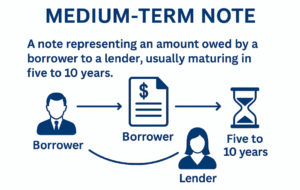
A medium-term note (MTN) is a legal document that represents an amount owed from a borrower to a lender or investor. Notes generally include a principal amount, or face value, that is lent to the borrower and is expected to be repaid at a later date, in addition to scheduled interest payments. Notes can be thought of as a form of fixed income security that is similar to a bond. A note “usually” matures in five to 10 years. A corporate MTN can be continuously offered by a company to investors through a dealer with investors being able to choose from differing maturities, ranging from nine months to 30 years, though most MTNs range in maturity from one to 10 years. The notes can be issued by various organizations and entities, including federal governments, state or provincial governments, municipal governments, corporations, Banks, non-profit organizations, etc.
understanding a medium term note ?
By knowing that a note is medium term, investors have an idea of what its maturity will be when they compare its price to that of other fixed-income securities. All else being equal, the coupon rate on an MTN will be higher than those achieved on short-term notes. For corporate MTNs, this type of debt program is used by a company so it can have constant cash flows coming in from its debt issuance; it allows a company to tailor its debt issuance to meet its financing needs. Medium-term notes allow a company to register with the Securities and Exchange Commission (SEC) only once, instead of every time for differing maturities.
In order to distinguish medium-term notes from other notes, the definition of “medium term” must be identified. Generally, when comparing fixed-income securities, all else being equal, medium-term notes will come with a higher stated rate or coupon rate than shorter-term notes. It is because, to compensate for the risks associated with lending money for a longer period of time, an investor will demand a higher yield. Following that logic, a long-term note will generally offer a higher stated rate than a medium-term note. Various organizations or corporations may issue MTNs and can continuously offer the notes through a dealer. A dealer represents market actors who buy and sell securities from their own account to provide liquidity and make markets within the securities markets. It is in contrast to brokers, who buy and sell securities on behalf of another party. Investors can select different maturities ranging from short term (less than a year) to long term (30+ years). However, medium-term notes are distinguished by offering a maturity of five to ten years.
advantages of a medium term note ?
MTNs offer investors an option between traditionally short-term and long-term investments. This can be ideal for situations where the investor’s goals fall into a time frame beyond those offered by certain municipal bonds or short-term banknotes without having to commit to the long-term note options. Businesses can benefit from MTNs based on their ability to provide a consistent cash flow from investors. Additionally, businesses can choose to offer MTNs with or without call options.
While the rates associated with call options are often higher, the business maintains the right to retire or call the bond within a specified period of time before the bond reaches maturity. This allows businesses to take advantage of lower rates, should they occur before a bond series has reached maturity, by calling in the bond issue and then issuing new bonds at the lower rate. Non-callable options do not have the same level of risk regarding the duration of the investment, which leads them to be offered at lower rates.
Advantage from an Investor’s Perspective:
Investors may prefer medium-term notes if they match the time horizon that the investors are seeking. Some investors may not need capital in the short term but may eventually need funds in the long term. The investors may want higher yields than short-term notes but may still require liquidity in the long term.
For the investors, medium-term notes are an ideal alternative since they offer a higher interest rate than short-term investments and are preferable as opposed to continuously renewing low-yield, short-term investments.
Making repeated short-term investments exposes investors to reinvestment risk, which is the risk that an investor may not be able to reinvest cash flows at the desired rate of return. The risk is more pronounced in an economic environment with decreasing interest rates. Medium-term notes allow investors to remove this risk in the medium term and lock in a specific yield over the life on the investment.
Medium-term notes offer investors the advantage of offering a wider range of investment options to choose from. Investors looking to invest within the medium-term notes market can choose among several investment options regarding the nature, size, and time length of the investment.
Advantage from an Issuer’s Perspective:
Issuers of medium-term notes can benefit from the consistent cash flow generation provided by offering the notes to investors. It allows issuers to issue notes as needed to meet their financing needs. For example, if a company needs to fund a large upcoming project but is short on cash, it can issue medium-term notes to investors to raise funds at a lower cost than issuing a long-term note.
Issuers also retain the flexibility to issue notes with embedded options such as call options.
options of a medium term note ?
Investors looking to participate in the MTN market often have options regarding the exact nature of the investment. This can include a variety of maturity dates as well as dollar amount requirements. Since the term involved in an MTN is longer than those associated with short-term investment options, the coupon rate will often be higher on an MTN while being lower than the rates offered on some longer-term securities.
A call option on a note is also referred to as a callable note or redeemable note, and it allows the issuer to redeem a note before its stated maturity date. Essentially, it gives an issuer more flexibility if they wish to pay off their debt early.
It may be ideal in an environment when interest rates are decreasing, since an issuer can repay the note, then either refinance or issue a new note at a lower interest rate. Because of the flexibility, investors typically demand a higher interest rate on a callable note, as opposed to a non-callable note, to compensate for the risk that an issuer may redeem the note early.
WHy MTN’s are so in demand for trading?
MTN’s are hot for trading. for several reasons. Let me give you some examples:
A bank or institution wants to issue an MTN for 1.000.000.000 USD ( this is called the Face Value – FV) for a period of 10 years ( we call this the maturity) and with an interest rate of 3% (we call this the coupon). This coupon can be paid out yearly, per six months or whatever the issuer provides.
When the MTN comes available on the market it will be sold (traded) for (this is an example and will vary from MTN to MTN) only 50% of the Face value. The first trade is called “FRESH CUT”. Later this MTN will be traded for bigger amounts. And that continues. Here we say the MTN is “seasoned” => had multiple trades. This is important for traders. Once an MTN is seasoned it is “TRADABLE”. Not all MTN’s end up in trading and will only be bought as a “medium term investment”.
Many MTN’s are traded by an OTC desk (Over-the-counter Desk).
What is an OTC-Desk? An OTC Desks conducts over-the-counter (OTC) trades with its clients. Instead of matching buyers and sellers, the OTC Desk will act as a dealer for anybody looking to trade a given asset. OTC Desks are generally used when a given trade would not be possible on exchanges. This could occur if the asset doesn’t trade on the exchange at all. Alternatively, if an order is large a trader may wish to conduct it with an OTC Desk to limit their market impact and slippage.
In most cases OTC Desks will take a position and execute the transaction for you. That means you confirm the amount to buy/sell and they’ll execute the transaction. However, some OTC deals involve matching buyers with sellers. These situations make trust and execution difficult. The buyer and sellers are often separated by hundreds of miles and possibly have language barriers.
We always recommend meeting the people you’re buying and selling to (ideally in person) as a pressure gauge for trust. Especially for the first time you want to transact with them. If the people are honest, transparent, and willing to disclose any necessary documentation. That’s normally a great sign that you are in the right place. With high value trading, it’s important to always feel comfortable with the people who’ll be sending and receiving your funds.
Make sure the OTC Desk is a LICENCED trade desk or at least the main trader has a trade licence! It does not need much explanation that these type of transactions might attract scammers and fake people, because they think they can cut corners like not providing KYC or CIS, try to do the transactions with “off-ledger funds”, etc. Professional OTC Desks will go through the paperwork in exactly the same way the bank does. And because for some restrictions they might be more sceptical than even the banks would be.
Another suggestion we can present is to do the transaction in the office of the bank. Bring both parties together in front of the bank officer, sign the DOA and other transaction documents there.
We at VAISCIN International, are well connected to an OTC Desk and can provide access to the Buy and Sell program for MTN’s. Please contact us privately for this service.